
The Elements, Temperament, and Constitution
Or, what sort of bender are you?

I recently finished rewatching The Legend of Korra, which is the follow-up series to Avatar, the Last Airbender. Korra is well worth watching, in case you’ve only seen Avatar—and if you haven’t seen Avatar, then you most definitely need to hop on that next time you need some nourishing soul food.
In the Avatar/Korra universe, humans have the capacity to bend different elements, shaping them to their will. In many respects, the concept of someone having an elemental affinity is the same as the houses in Harry Potter. Air-benders are equivalent to Ravenclaw, Fire-benders (who are mostly the bad guys in Avatar) to Gryffindor, Water-benders to Slytherin, and Earth-benders to Hufflepuff, which, at least to my approximation, are the only ones that are not dramatically different between the two series.
Each series has a different simplified take on the elements, but it’s the same notion—and one that has deep roots in our own culture, too. It’s not hard to feel that there’s a subtle clan that we belong to—perhaps going through our family lines, but also maybe not. We often have a sense of kinship with the external world, a sense that our unique character has a connection with external elements of life. Infinite possibilities of this— from spirit animals to affinities with different genres of music—but the elements are one of the most universal ways that’s formulated.
The four-element system is incredibly widespread—aside from the Western esoteric tradition and the cosmologies that stem from Greek philosophy, we see the four-element system prominently in many shamanic systems and Tibet, although sometimes with an added quintessence, spirit. In the Western tradition, this four-element system became incredibly important as the basis of humoral medicine, which was pretty much the main school of thought until the 1700s or so (Galileo taught medical astrology, which is centered in humoral medicine, at the University of Padua). In this worldview, everyone has a specific elemental affinity or constitution (also called temperament or complexion), each of which is associated with a different liquid in the body (humors) and a particular set of tendencies and potential health problems. Sanguines are connected with the element of air, blood in the body, and nervous/mental problems; Melancholics are connected to the earth, black bile, and contraction/ossification in the body; Cholerics to fire, yellow bile, and inflammation; and Phlegmatics to phlegm, the element of water, and congestion/liquid retention.
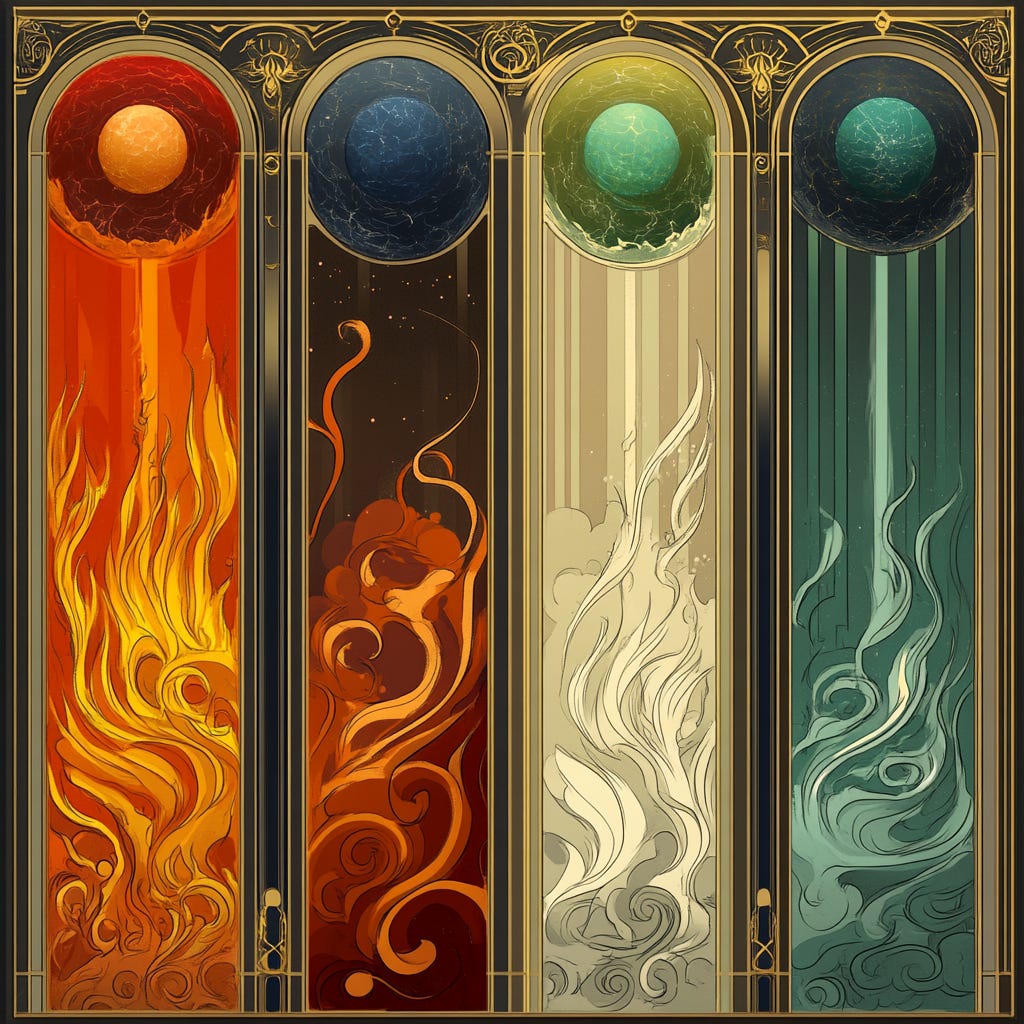
What the elements actually signify in terms of personality varies, but the elemental archetype remains clear. Sanguines are thought to be connected to sociability and the potential to fall into vanity. Melancholics are often just kinda focused on what they’re working on/what they’re up to, and may or may not have the sad melancholy attributed to their name. Phlegmatics have an orientation toward pleasure and concern with the internal world of emotions. Cholerics are the fiery, assertive types, and typically, you don’t want to get on their bad sides.
The idea of constitution also points us to our unique health needs. Each temperament can tend toward an extreme, which typically needs to be balanced out or nudged along in the process of transformation. Humoral medicine is typically based on counterbalance—dryness needs moisture, cold needs heat, etc.—as opposed to the homeopathic principle of like cures like. Counterbalancing something is thought to be faster in relieving symptoms, but working with the homeopathic principle purportedly leads to longer-lasting cures.
Constitution also describes what we need in order to feel balanced or healthy - how we can nourish ourselves. I find this is more psychological than material—it’s important for Cholerics to have challenge and enthusiasm, but too much spicy food or stimulants in their system is a recipe for illness (usually starting with an upset stomach). Here, the ideal of the Avatar, a master of all four elements, becomes an ideal of health—we need to be able to work through and balance our internal humors to live an enduringly healthy life.
Temperament can also provide a platform for understanding how to deal with one another, as opposed to the one-size-fits-all approaches that modern science is wont to. We human beings are radically different from one another, and one person’s poison is another’s medicine. Waldorf education retains this temperamental understanding and seeks to meet each child according to their temperament. This is in part because of the particular detrimental extremes each element can go to, but it’s also about understanding what each child needs in order to thrive.
Steiner gave this banger in one of his lectures on temperament: “without the temperaments the world would be an exceedingly dull place, not only ethically, but also in a higher sense. The temperaments alone make all multiplicity, beauty, and fullness of life possible. Thus in education it would be senseless to want to homogenize or eliminate them, but an effort should be made to direct each into the proper track.” (GA 57)
Interestingly, Steiner also specifically said that, “Temperament stands between the things that connect a human being to an ancestral line, and those the human being brings with him out of earlier incarnations.” Thus, temperament is a sort of blending of our unique spirit and the genetic/family situation in which we’re born. Importantly, we can each have a sort of blended temperament—I think I’m decently Melancholic (or rather, an earth-bender), but I’ve got a good bit of Sanguine/air-bender in me, too. Often there are sort of primary and secondary temperaments, which express themselves in different contexts.
Astrology can be helpful in calculating temperament, but sometimes this isn’t necessary —especially if we’ve spent a good bit of time with someone and they have a clear temperament, we generally know how they’re going to navigate the world. Astrology’s got great tools for understanding temperament, though, ranging from the quite simple (what signs fall in your first house?) to the complex (looking at the ruler of the ascendant and moon and aspects to them, as well as semi-intuitively assessing which planets might have outsized importance). The ancient world didn’t know about the outer planets, though, and I find them to be very helpful in understanding someone’s temperament. I’d compare this to the way that some fantasy universes are based on the four-element model, but some have way more nuance: Magic the Gathering and Pokemon, for example, have tons of different elements, like shadow energy, electric energy, and psychic energy, which would roughly correlate to Pluto, Uranus, and Neptune. The Avatar universe starts to explore in this direction—in the series, we discover that there’s also lightning bending and metal bending, and in Korra we see lava bending. I personally resonate with this more precise elemental delineation—I think I’ve got a good bit of lightning bender in me (and I’ve got a Sun-Uranus conjunction).
I’m curious - do you have a strong affinity as an elemental type? Do you have an understanding of your constitution or what type of bender you are? Drop a comment or send an email and let me know!
As always, please reach out for a reading if you’re interested in diving into your astrology with me.
And now for the play-by-play of the next couple of weeks for the paid subscribers!
